
This is the fourth installment of New Gamemaster Month!

In New Gamemaster Month we’re helping players who feel the urge to run an RPG—to become a GM for the first time—take the plunge. If you’re just joining us, start with the first installment. Then join us every Tuesday and Thursday throughout January, and by the end of the month you’ll be a GM too!
On Tuesday, we started digging into the rules and setting of our games. Developing a basic fluency in these topics—without sweating the details too much—gives you a foundation for keeping your game sessions flowing at a brisk and enjoyable pace, and allows you to form and run with your creative ideas and those of your players without the distraction of wrestling with unfamiliar rules.
So if that’s the foundation, what do we build upon it? The adventure, of course!
What Is an Adventure, Really?
An RPG adventure is a planned series of events that give a backbone to the story you, and especially your players, will unfold around the gaming table. As you develop your skill and experience as a GM, you might take great pleasure in crafting your own adventures. Or you might prefer to save yourself the effort and use the many fun and imaginative adventures already created for your convenience. Many GMs do both—they run published adventures when they have little prep time or are particularly inspired by the adventures’ ideas, and they make their own when they have the time and inspiration to do so.
Creating your own adventures isn’t hard. The amount of work required varies from game system to game system, but generally isn’t insurmountable. It’s a slightly different skill set than GMing in general, though, so it’s outside the scope of the New Gamemaster Month program. We’re going to go with a published adventure, to focus on the actual GMing process rather than the design process.
Before you flip open your adventure, let’s talk a bit about what an adventure consists of. Adventures can be highly detailed, or amount to little more than a few notes, but they all have a few things in common:
- An initial set of circumstances (an isolated village in the wilderness; a caravan encountered on the road; a treasure map that suggests a trip into the mountains). Often, a published adventure will offer a variety of “hooks” for involving player characters (suggestions for why they might come across that isolated village in the wilderness, for example).
- A conflict that compels the players to become involved (villagers have recently been disappearing; the caravan driver offers a big reward to help fend off local marauders; the treasure map hints at great riches).
- An outline of how the adventure’s story is likely to unfold. Sometimes the outline is very linear (event A leads to event B, which leads to event C). Sometimes the outline is “squishier,” with few or no assumptions about the order of events. And sometimes the outline takes the form of a map: The classic D&D dungeon is basically an adventure outline, with the passages and tunnels indicating how the events might connect to each other. The outline might be drawn out like a flow chart (or, again, take the form of a map), or it might just be a list of encounter descriptions. That takes us to:
- A set of encounters, or scenes. An encounter is a point at which something happens, and, typically, where the characters learn or gain something that moves their story forward. Encounters might involve combat, or a trap, or social interaction, a period of exploration, or some sort of environmental challenge.
- Finally, an adventure contains details on creatures, characters, and items the player characters will interact with during their encounters. This might include stats for creatures, descriptions about personality, appearance, and motivation for non-player characters, maps of adventure areas, lists of “loot” and other interesting in-game items the characters interact with, and illustrations of places, characters, or events.
Those are the components of any complete adventure. They might take the form of a 96-page book with thousands of words of detail, along with dozens of maps and images. Or they might amount to a few scribbled notes on a sheet of paper. Either way can suit the purpose just fine.
So if those are the basic ingredients, what does it take to make a really tasty meal out of them? A great adventure:
- Often has an element of mystery, or even a plot twist somewhere in the middle. That initial conflict was compelling, but it turned out to be just the tip of the iceberg!
- Has some element of story—often a very strong narrative—but doesn’t rely on or expect a specific course of action from the players.
- Usually has a variety of activities in it: Fighting, negotiating, exploring, working out puzzles or mysteries.
- But also plays to the interests of the players and the strengths of the characters. Players who love fast-paced action may become bored by an adventure that’s heavily focused on intrigue and social interaction. And a character that’s great at climbing, crawling, and sneaking around won’t get a chance to shine in an adventure that’s a series of straight-up combat scenes.
Running Your First Game Virtually
If you’re used to sitting in the same room with your friends, you may find that a virtual game creates a sort of “invisible barrier” between the participants. A distraction for one person (a TV on in the next room, for example) isn’t a distraction for everyone else. You’re all sitting in front of computers, so someone checks email. Or scrolls through Instagram. The technology gives the illusion of proximity, but there’s still a psychological distance between everyone. The invisible barrier is unique to online play, but there are a few steps you can take to reduce its effect.
The first step to overcoming the invisible barrier is recognizing that it’s there and that it affects players differently. The person in the later time zone sitting in the dark starts to get sleepy. The person who’s more prone to distraction has greater opportunity to let their mind wander. Players who otherwise would be attentive if they were sitting among their friends find that they can’t sit alone in a room doing nothing while someone else takes a turn, so they start scrolling through social media.
It’s a bit trickier to keep everyone engaged in the digital environment. So if someone’s quiet, address them specifically and ask what they think, what they plan to do, or something of that nature. Make sure everyone interacts at least once every few minutes of play.
This isn’t just the GM’s problem to solve, by the way. Remind your players about the invisible barrier at the beginning of the game, and ask them to be mindful not just of their own engagement, but also that of the other players.
It’s time to get to the specifics of your first adventure as a GM.
A Little Reading
Read Taker of Sorrow, on pages 363-375.
A Little Thinking
As you read it, think about the elements discussed above—both the fundamental building blocks, and the factors that make an adventure fun and successful. See if you recognize those elements in the adventure. Maybe you’d like to hop into the New Gamemaster Month Facebook group and talk about them with experienced GMs and other folk, like you, who are exploring GMing for the first time.
And a Little Talking
But that’s not your only activity. As mentioned above, an adventure works best if it plays to the interests and expectations of the players. So have a chat with them. Ask them what they expect and want out of the game. Some players will be happy to go on at length. Others might not really know what they want, or be able to articulate it. In some cases, you may have gamed with the player before, and perhaps already have a good sense of his or her play style. That’s all fine. The goal here is to put yourself in a position in which you can best prepare for a game that everyone will find memorable.
Don’t press your players on this—many gamers don’t really care to think about a game too much before they sit down at the table with a character sheet in front of them. But if you have players who are eager to think ahead about the game to come, you might tell them about shin obligation, and share some of the personal hooks, and other reasons to be involved in the adventure, given on page 365. And of course they aren’t limited to talking to you—they’re welcome to discuss their character ideas with one another beforehand, too.
Let us know how it goes in the New Gamemaster Month Facebook group. And talk to you again on Tuesday!
Since you have a basic idea of how the rules work now, it’s time to dig your claws into your first adventure as a GM!
Read the Adventure
You’ll be running “Magical Kitties Save the Library,” on page 23 of the River City hometown sourcebook. Here’s a quick summary to get you started …
This adventure is a simple mystery with clues located in various locations. The kitty krew’s humans have disappeared! They discover that they’re trapped inside magical books at the River City library, which are actually portals to fictional mini-dimensions. The kitties need to find the right books and rescue their humans, then confront the librarian witch who’s responsible.
- For the hook, the kitties discover their humans are missing, and clues lead them to the River City Library.
- In the lobby, they negotiate with the talking books of the Display Council, and get hints on which sections of the library to visit next. They can do that in any order.
- In the Children’s Room, they enter the fairytale dimension of Hansel and Gretel.
- In the Fantasy and Sci-Fi Section, they visit the historical fantasy world of knights and ladies in The Once and Future King.
- In the Natural Science Section, they venture inside The Dinosaur Guide.
- The big finale is in the library offices, where they convince the good witch Preeti to stop kidnapping humans (even if she thinks she’s helping them).
We’ll be back on Tuesday to talk about encounters, and tweaking them for your specific players! 😼
It’s time to get to the specifics of your first adventure as a GM.
Trail of Cthulhu adventures use a specific format to help you run the mystery smoothly.
- There’s a Hook that tells you how your players get involved in the mystery. In the case of Midnight Sub Rosa, they’re sent to recover the diary of Ezekiel de la Poer.
- There’s a Spine – a set of scenes that you’ll play through as you move through the mystery. Some of these are core scenes, and are required to tell a complete story. Others are alternate or optional scenes. Scenes are linked by
- There’s a Horrible Truth – the revelation of what’s really going on.
- The adventure may include some additional preliminary material – Midnight Sub Rosa, for example, has descriptions of some of the really important Non-Player Characters (NPCs), and notes on presenting the setting of rural Alabama in the 1930s.
- Then, there’s a list of Scenes – the real meat of the adventure. Think of these as scenes in a movie or a stage play, only the script isn’t finished and there’s plenty of room for improvisation and surprises. You’ll set the scene by describing what’s going on (“you’re all in a big country mansion”), and you’ll act out or describe the parts of the NPCs (“Professor Derby greets you warmly, and asks if you had any trouble getting here”), but it’s up to the players to decide what their player characters do.
- At the start of each scene, we list Lead-ins and Lead-Outs. Lead-Ins are scenes that can lead to this one; Lead-Outs are the scenes that likely follow on from this one, depending on which clues the players find with their investigative abilities. You can see an overview of how all of the scenes connect in the Scene Flow Diagram at the start of the adventure.
- Remember the core idea of GUMSHOE – it’s more fun for the players to get lots of clues, and have to work out what they all mean, than it is for them to get only scraps of information and blunder around the dark. Be generous with your clues!
- Investigation is only half the fun, though – it’s a horror game, too! The various scenes have lots of atmospheric details, a selection of eccentric spooky characters for you to play, and monstrous abominations to threaten your players with. When you run the game, you need to build and modulate that atmosphere of horror for your players. Take your time and let them get to know the various NPCs, and let them speculate nervously about what’s going on. Let the tension grow – and then shatter it with a spasm of sudden violence when the ghouls attack!
A Little Reading
Take a look at p. 191 to 203 of Trail of Cthulhu, which is a master-class in building and running adventures, and gives you the tools you’ll need to get the most out of Midnight Sub Rosa.
Read the first 13 pages of Midnight Sub Rosa, and skim the rest of the scenario. Pay attention to the Scene Flow Diagram, so you can see how the various scenes fit together.
A Little Thinking
As you read it, think about the elements discussed in the previous steps—both the fundamental building blocks, and the factors that make an adventure fun and successful. What bits of this adventure appeal to you? Are you more excited about the intrigue and character interactions in the Derby house, or the prospect of chasing around graveyards and examining corpses for clues? Which chills you more – the thought of inhuman monsters like the ghouls, or Irma Derby’s horrific plan to resurrect her mother using forbidden magic?
Maybe you’d like to hop into the New Gamemaster Month Facebook group and talk about the adventure with experienced GMs and other folk, like you, who are exploring GMing for the first time.
And a Little Talking
But that’s not your only activity. As mentioned above, an adventure works best if it plays to the interests and expectations of the players. So have a chat with them. Ask them what they expect and want out of the game. Some players will be happy to go on at length. Others might not really know what they want, or be able to articulate it. In some cases, you may have gamed with the player before, and perhaps already have a good sense of his or her play style. That’s all fine. The goal here is to put yourself in a position in which you can best prepare for a game that everyone will find memorable.
Don’t press your players on this—many gamers don’t really care to think about a game too much before they sit down at the table with a character sheet in front of them. But if you have players who are eager to think ahead about the game to come, then tell them that their characters are part of the Armitage Inquiry, a group associated with Miskatonic University that investigates the occult. What sort of character do they plan on playing? Tweedy professor, two-fisted gumshoe, mysterious occultist, or a socialite with a dark secret?
Alternatively, you may wish to use the pre-generated characters that come with the adventure. These sample player characters are almost ready to go – all the mechanical work is done, but the players will still need to come up with some background details and personality traits. Is Lucia Escobar a stuffy academic or an eccentric parapsychologist who chases after every fringe theory?
Let us know how it goes in the New Gamemaster Month Facebook group, or by tweeting to @NewGmMonth. And talk to you again on Tuesday!
Alright, it’s finally time for you to get nice and familiar with the adventure you’ll be guiding your players through.
“The Cursed Farm” is a relatively simple and quick adventure that is intended to be finished in a single night of play, so it’s ideal for a first foray into the world of gamemastering.
Page Turning
Read the adventure through once. Since you did your earlier skimming to understand the basic situation, now you’re just filling in the blanks with specifics and with more information. Again, you don’t need to memorize anything; you’ll have the entire adventure in front of you when you’re running so you won’t need to remember all the little details.
Thought Tumbling
As you’re going through the adventure, there are a few things to consider and make decisions about.
The farmstead has several characters that the players can talk to for information. If one of those characters stands out to you, make them the focal point for the players to engage with. Would you have more fun roleplaying as the noble but stressed-out farm-owner Björg, the loyal ex-outlaw Ulfur, or the young thief with something to hide Leifur? You don’t have to pick just one, and players are likely to talk at least briefly with all of them, but as the gamemaster you have a lot of leeway in deciding which nonplayer characters (NPCs) speak up when the players ask a question.
Now try to consider what your players might want to know that isn’t presented by the adventure. Is there some question they might ask that doesn’t have a direct answer provided? Think of three to five questions that you anticipate your players will ask and be ready with the answers. And if the answer isn’t provided in the adventure, just make it up! Players will always surprise you with the questions they have or the plans they come up with so it’s impossible to predict all of them, but try to at least consider what they might do.
Chin Wagging
If you already know your players well or have played roleplaying games with them before, this step might be a little easier. If not, you’ll have to do some polite digging.
Find out what kind of games your players like. If one of them really enjoys honorable duels, that’s valuable information. If another always does the talking and negotiating, or a third always plays a low-down thief that picks everyone’s pocket, you should know about it.
This knowledge will help you tailor the adventure to suit your players. If one player always wants to play the strongest fighter and likes to challenge enemies to duels, guide them to pick Njállas their character (he’s the best fighter of the bunch) and keep that in mind for when the heroes eventually encounter the draugur by the stream. If someone likes to negotiate and talk, show them Sigmundur and nudge them to the front of the group when talking with the residents of the farmstead.
If you already know your players and have played with them in the past, you can probably guess as to their general habits. If not, just ask! Some of them won’t be able to answer, and that’s okay. Once again, the worst possible outcome for this step is that you have no more information than when you started.
Pieces of a Mystery
The secret with Monster of the Week, as with most games Powered by the Apocalypse, is that you only need to set up the beginning of a Mystery, and don’t need to worry about where it will end: the Hunters will figure that out for you.
But… how do you set everything up? Every Mystery is broken into four basic parts: the basic concept, the hook, the threats, and the countdown. In our sample adventure, these are already outlined for you. Once you get familiar with how all these concepts interact, you’ll be creating your own Mysteries in no time. Let’s take a quick look at each piece:
Basic Concept: The core premise. In “Dream Away the Time”, the basic concept is that the village has forgotten about their long-standing pact with the King of the Faerie and now he’s sent his forces to punish them.
Hook: The incident or element that draws the Hunters into the Mystery. Handfast suffers a series of strange weather events, a rash of curious attacks, and unusual household mischief. You’ll describe the hook to the Hunters, how they deal with it is up to them.
Threats: These represent anything which could challenge the Hunters. It could be a monster, it could be minions of the monster, even locations and bystanders can present a challenge to the party. (Explaining to an innocent bystander why you’re performing an infernal divining ritual over the corpse of a rapidly-decomposing hell cat is not as easy as you might think.)
Each threat has a motivation which gives you insight as to how the threat will respond to the Hunters’ actions. For instance, Officer Edward Turner’s motivation is “to pass on rumours.” So rather than responding to the Hunters as a gruff, man-of-action, Officer Turner is genial, loquacious, and clearly in over his head.
Countdown: This is what would happen if the hunters never got involved to deal with the situation. The countdown always starts at Day and moves steadily toward Midnight. (These steps are metaphorical, not literal. The names are just intended to give players a sense of things getting worse.) In Dream Away the Time, the countdown starts with Violet and Bonecruncher causing trouble in Handfast. If the Hunters don’t successfully put a stop to events, Bonecruncher eventually eats them or drives them from their homes.
Sections to Read & Review: Creating Your First Mystery (pages 132-147); Introductory Mystery: Dream Away the Time (pages 149-161.)
If You’re Using Roll20
Here is a special treat: the Keeper gets their own mystery sheet, in a sense the adventure is your “character.” To see how it works, create a new character and when selecting the playbook, choose “Keeper’s Mystery Sheet.” You will then see fields for the mystery concept and the hook. Immediately below you will see all the cheat sheets you will ever need: the Hunter Moves Reference, the Keeper’s Reference, and the instructions for using the mystery sheet.
Clicking the +Add button will let you add a new countdown, monster, minion, bystander, location, phenomenon (a new threat type from the Tome of Mysteries supplement), or generic text block for your own notes. Each threat gets its own box where you can add all their information, keeping everything in a single location rather than shuffling between multiple character sheets. To see an example of a completed sheet, Dream Away the Time has its own pre-populated sheet included in the module.
“Adventure.” I guess that’s a word for it.
Here’s what we assigned you last week.
- Primary Objective A: Learn the Delta Green setting (COMPLETE).
- Primary Objective B: Learn the game’s rules by reading Need to Know, pages 5–19 and 33–39.
- Bonus Objective: Watch or listen to actual plays of Delta Green.
You reviewed the scenario “Last Things Last,” pages 41–48 of Delta Green: Need to Know, in Week One to help inform players about what is coming. Today, we prepare to deploy the scenario at the table.
There Are Only Three Scenes in “Last Things Last”
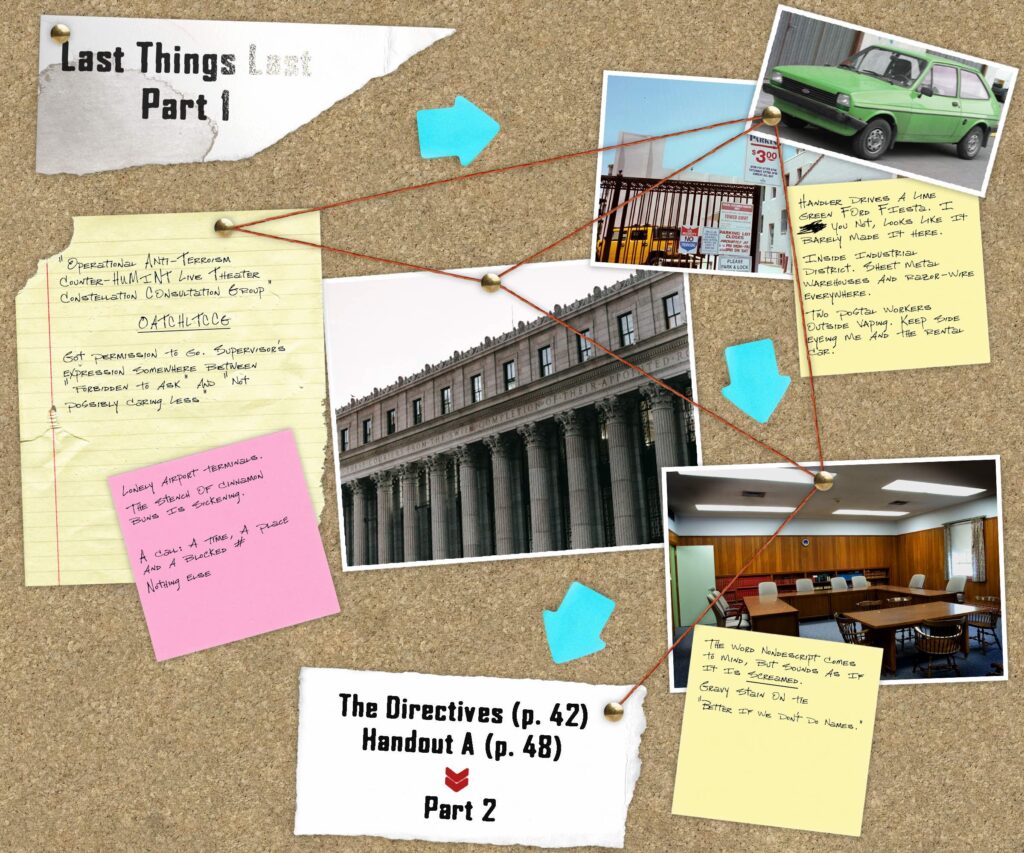
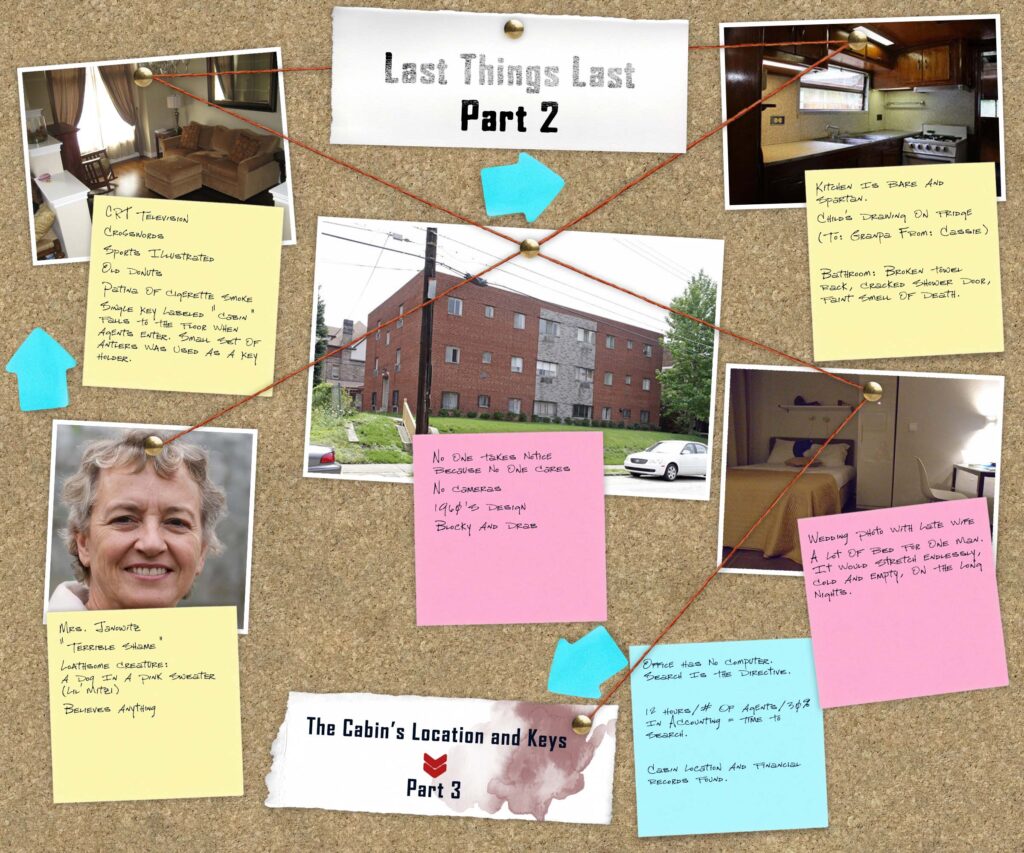
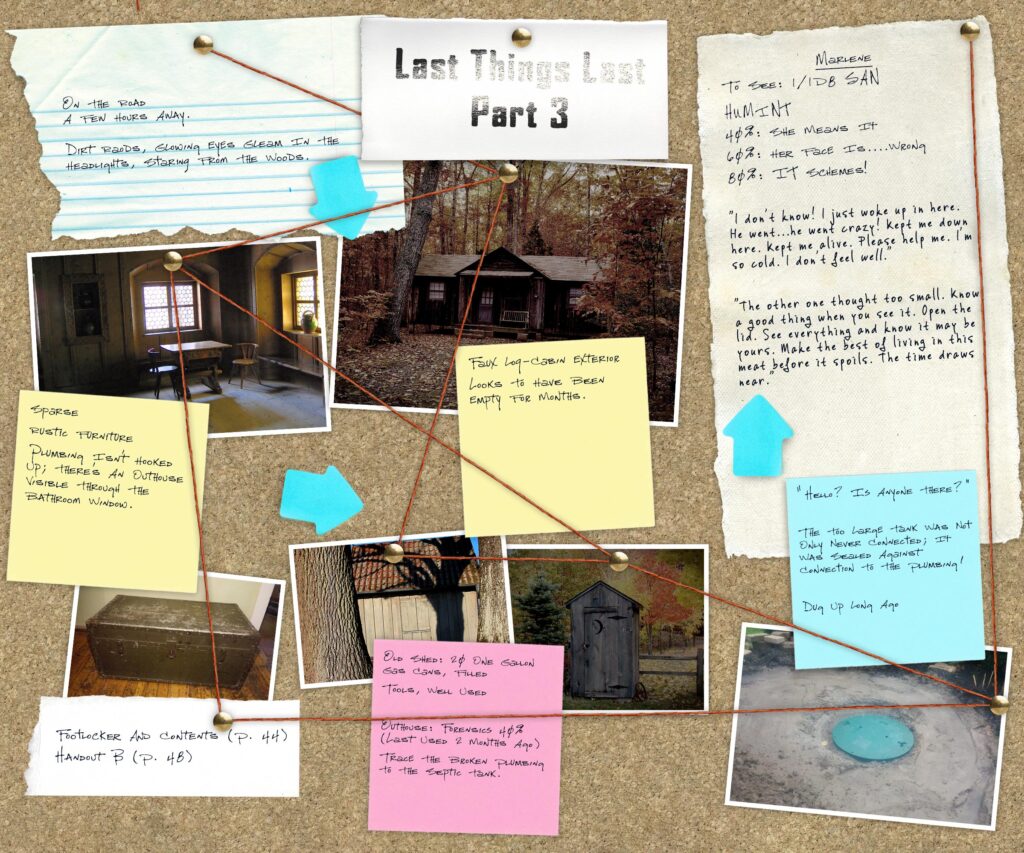
Things start at the post office briefing. The first part of the investigation happens at Clyde Baughman’s apartment. It ends at his cabin in the woods. In terms of plot, the scenario couldn’t be simpler. It’s very hard for Agents to get off track. Let’s talk about tips that make the game run well.
Delta Green is about mood, so map the mood.
The description of each location in “Last Things Last” is choking with evocative detail. Consider highlighting sections of the text that you can quickly insert into descriptions or use to answer player questions. Write a location name on a piece of scrap paper and surround it with a “cloud” of tags pulled from both the text and your own imagination. For example, I’d write down “Post Office” and surround it with descriptive tags useful for setting the mood, such as, “Handler has deep bags under eyes,” “gravy stain on shirt,” and “MIA/POW keychain.”
But what moody details should you map?
The life of an Agent is about despair; the work of an Agent is about terror.
The literary term for the government side of an Agent’s life might be Kafkaesque. Agents don’t work for Delta Green. That’s volunteer work on the side. They earn their livings as FBI agents or lawyers or doctors or government contractors. They live with the same mundane drudgery as the rest of us, made all the more unbearable by the dark truth of the unnatural.
Delta Green fights an endless war of attrition: an underfunded and illegal mission that daily seems more hopeless and doomed. Above all, Agents must keep their terrible and ultimately criminal actions secret. The boredom and futility of everyday life are punctuated by moments of paranoia.
This drab, pessimistic existence transitions into an atmosphere of existential dread and visceral terror when confronting the unnatural. When you’re talking about past DG jobs or dealing with the thing in the septic tank, the literary influences shift into the Lovecraftian mode: horrors from beyond reason that evoke cosmic terror in the Agents and, in your best moments, the players themselves.
Agents always move forward, with or without the means to survive.
After mapping the three scenes detailed in the scenario and clouding them with mood—briefing, apartment, cabin—draw lines between them and label each line with the vital clue it represents. The briefing (page 41) takes the Agents to the apartment. Someone in the apartment has to find the keys to the cabin or records of its existence (page 42). Once at the cabin, someone has to notice the footlocker and Baughman’s note directing them to the septic tank (page 44).
If you’ve read the scenario, you know that this is only enough information to get into trouble. There’s no reason Agents must be fully equipped to deal with the thing in the tank (page 45) before they meet it. As the Handler, it is your job to take the story from beginning to end. Let the players about whether their Agents survive the trip.
If Agents go off the rails, detour into real life before directing them back to the plot.
Agents sometimes hunt false leads and go to places not outlined in the scenario. Don’t worry. The world of Delta Green is nearly identical to the lived experience of people outside it. If the Agents want to hit up a convenience store for supplies on the way to the cabin, pull descriptions from one you are familiar with. Go for the worst version of a place you can find in your memories. If they want to go to a bar, make it the seediest one you’ve ever seen. If it’s a rest stop, describe the toilets broken and overflowing. Use these diversions to maintain the mood. Then remind players of the mission objectives to get them back on track.
You know what? Just let me draw that map.
It may make a useful example. I can be…kind of a control freak about the details. You’ll get that way about the small stuff, too.
If you make it that long.
Welcome to Session 4 of New Gamemaster Month for the Tales of the Valiant roleplaying game! Last time, we talked about rules. This time, let’s focus on storytelling.
Last week, we chose an adventure for your first session. We decided on Kobold Press’s fan favorite, The Impregnable Fortress of Dib, to provide a smooth introduction for both the GM and players.
If you haven’t downloaded a copy yet, get it for FREE using the link below.
As you embark on your first adventure as a game master (GM), pay attention to three key elements:
The Story
The Impregnable Fortress of Dib is designed as a straightforward, three-page adventure. This format provides enough building blocks for the structure while allowing you the freedom to create a story that responds to what the players do. To fully grasp the story, be sure to read the entire adventure first.
- Open the PDF and read the Introduction on page 3.
- Read the complete adventure from pages 4–6.
Note: You do not need to read the second adventure, Dib’s Wagon of Doom. You can stop at page 6!
The Structure
As you read through the adventure, consider the elements that contribute to its enjoyment and what will make it successful in gameplay. Your GM notes might cover the following points:
- What is the beginning, middle, and end of the story?
- Identify the who, what, when, where, and why based on the text.
- Where can you incorporate your own unique bits, and how can you engage the characters effectively?
Look for these elements as you read the adventure. You might also want to join the Kobold Press Discord to discuss your insights with experienced GMs and others who are exploring GMing for the first time.
The Players
An adventure is most effective when it aligns with the interests and expectations of the players. This is the perfect opportunity to talk with them about what they expect and hope to experience in the game. Some players may share their thoughts at length, while others might struggle to express their preferences. Both are good starts!
This is also a great time to discuss scheduling a session 0, where you can build characters, establish safety tools, and clarify expectations before gaming. Kobold Press recommends using the Deck of Player Safety to implement accessible safety tools at your table.
If you’ve gamed with some players before, you might already have a sense of their play styles. Regardless, your goal is to prepare for a game that everyone will find memorable.
It’s perfectly fine if your players don’t have answers to your questions right away. Many gamers prefer to dive in without overthinking it until they sit down with a character sheet in hand. However, if you have players who are excited to think ahead, consider finding a personal character hook or other reasons to help them engage with the adventure.
Remember, players aren’t limited to discussing their ideas solely with the GM; they should feel encouraged to collaborate with each other as well. They might discover an adventure hook that fits the entire party better than just a single character’s perspective.
We’d love to hear about your experiences in the New Gamemaster Month Facebook group. We’ll be back on Tuesday to discuss encounters!
Blood on the Range (pages 7-8) assumes that the characters are already riding together as a posse in Wyoming. They’ve heard about a $100 reward for finding a killer, and ride to Heath Crittenden’s ranch to investigate. After setting that scene, there’s a block of text for the GM to read out loud that sets a few important details, including the presence of a Ute war party nearby.
🕵️♂️ The Crime Scene
The proper adventure starts here, and the Survival rolls make a good introduction to Trait rolls. Anything else the characters try might lead to the same results: blood on the barbed wire and a total absence of other tracks. Once any investigations wrap up there’s two main directions the posse can go: out beyond the wire to question the Utes, or back to the ranch to investigate Hank’s body. If the players seem unsure, have Crittenden prompt them to track the Utes. They seem to him like the main threat. Once the posse returns to report what they find they can get a look at the body.
Alternatively, if the posse are keen on examining the body right away they can. Once they finish investigating, Crittenden can ask them to check along the boundaries (leading to the encounter with the Utes) or jump directly to the final encounter: Blood on the Wire.
Let the posse poke around, question cowhands, or whatever they think up. If you aren’t sure how to handle something, trigger Blood on the Wire. You can roll into that encounter whenever and wherever you need to, and so it’s always an option if things get stuck. The finale is an Encounter, so for a few words of advice about those next time!
It’s time to dive back into our adventure, The Portal Under the Stars!
The first thing to do is give a read through on the adventure! We already suggested you do this in a previous post, but a second reading goes a long way. The Portal Under the Stars is located at the back of your Dungeon Crawl Classics core rulebook, in the last section before the Index.
When you read through it this time, though, take time to consider what we’ve discussed up to this point. How are your players going to act and react to the various obstacles that are presented to them? How are you going to react to that in turn?
Gamemastering an adventure is as much about understanding your players and making their experience fun as much as anything else. DCC RPG is a very cinematic game in so many ways, allowing a lot of latitude in your player’s actions. Let them try things. There is no guarantee that they will be successful but allowing them to attempt the impossible is one of the things that makes RPGs so much fun.
Don’t Make Assumptions
Despite what we just said, make sure that your players are wanting the same thing that you do. If you are starting to run an action-packed thrill ride of an adventure, but all of your players are looking for introspective drama and romance, then they might not have a good time.
In fact, they might not know what they want before the adventure begins, and there is nothing wrong with that. Let them grow into the game and allow yourself to adapt to what they want.
The only way to do that is to talk with them. You don’t have to reveal secrets of the adventure, but you do want to have an open dialogue. Your players will want to trust that the Judge—that YOU—are there for the same reason they are, and if everyone goes in blind, then problems might arise.
Emergent Play
Dungeon Crawl Classics starts in a way that many games do not. We’ll go into depth on this in a later post, but all your players will be starting out with randomly generated characters who are NOT adventurers. They will be farmers, bakers, clergy, tailors, or any number of possible everyday people who are thrust into an adventure due to unusual circumstances. The beauty of this is that the players don’t go into the first adventure with a pre-conceived idea of what their character might be, but they discover it through a process that is called emergent play.
This means that over the course of events that happen in the adventure, your player’s character will blossom. They start out as a villager and end up as a hero of the realm. The adventure you are going to run is truly the first step they take on a greater path. It’s a chance to let the story and actions of everyone involved forge the character that they will play.
Drop by our Discord or the DCC Rocks! or New Gamemaster Month Facebook group to let us know how things are going! And we’ll see you next time as we delve into the meat of the adventure!
It’s time to get narrative and dive into the adventure! Grab the Quickstart Adventure from our Downloads page and read:
- Page 28, the Narrative Overview of all acts of the adventure
- Pages 29-36, the 5 acts of the full adventure
In the adventure, you’ll see stat blocks for adversaries and environments and instructions around potential combats. Don’t feel the need to get too into these, as we’ll dive into adversaries, environments, and encounters next time!
Also take note of the opportunities for worldbuilding and inviting your players in to describe the world around them. The Quickstart Adventure points this out directly, like on page 29 that gives an example question you cna ask your players: “You’ve noticed something unique about the look of trees here in the Sablewood. What is it?“ Remember not to treat the adventure as gospel—you don’t need to memorize word-for-word, and feel free to expand on what is there so it better fits your playstyle and your players’ story. Be adventurous!
Now is also a great time to look back at your pre-generated character sheets. Take note of their experiences, 3 connection questions, and personal question on their character sheets. This will give you insight into how the characters know each other and tie into the stories.
Talk to Your Players
Adventures work best when everyone starts on the same page. Check in with your players on what they hope to get out of your session—is this only going to be a one-shot, or might you return to play again? Are there any topics that the players want to ensure stay off the table? Are players excited for a more serious or silly session? Consider adding some basic safety tools to the table, which you can find in the Daggerheart Core Rulebook on pages 169-172.
Let us know how it goes in the New Gamemaster Month Facebook group and the Darrington Press Discord. Get ready for what’s coming next Tuesday!
Throughout this program, we have expert GMs on hand to answer questions and provide general support at the New Gamemaster Month Discord Server or the New Gamemaster Month Facebook group. Please drop in, join the group, introduce yourself, and ask any questions you might have. Other new GMs will also be there—it’s a great place to share your experiences and support one another. Hope to see you there!