
Welcome to the third installment of New Gamemaster Month!
In New Gamemaster Month we’re helping players who feel the urge to run an RPG—to become a GM for the first time—take the plunge. If you’re just joining us, start with the first installment. Then join us every Tuesday and Thursday throughout January, and by the end of the month you’ll be a GM too!
This week we’re going to spend a little bit of time learning the rules and setting of your chosen game, and a little time digging into the adventure you’re going to run. Let’s do the rules and setting first, then look at the adventure in Thursday’s activity. But first, a note about how all this relates to other roleplaying games.
Just This Game?
When we go into the rules and setting in this program, we’re going to be talking about the game you’ve chosen: Numenera, Unknown Armies, Trail of Cthulhu, RuneQuest, Monster of the Week, Delta Green, Tales of the Valiant, or Savage Worlds. As you learn those things, you’re learning that game. But our goal is to make you into a competent GM—no, let’s say a great GM—in general. With the limited time and bandwidth we have this month, we can’t teach you the specifics of every game out there, but the process by which you’re learning applies pretty much to any game. In three weeks you’re going to run a great session of your chosen game. Take the general skills you’ve learned, spend a little time with the rulebook, and a few weeks later you could be running FATE or D&D or Pathfinder or Cypher System. In other words, the most critical skills you’re picking up are easily transferred to any and all of your favorite games.
What If I Already Know This Game?
If you’re already a pretty experienced gamer—and particularly if you’ve already played your chosen game—some of what we go into today will be old hat. That’s fine, but it’s worth it to at least skim your way through today’s activity. It may fill in a few gaps in your knowledge base, and it will definitely help build your confidence. And as we’ll discuss, confidence is one of a great GM’s biggest assets.
Back to the Rules and Setting
Rules and setting are really critical to GMing, right? Weeelll, sorta. Here’s what’s really critical: Creativity, nimble response, and an engaging pace of play. You know what kills those three things faster than a ravage bear in a cavot pen? Stopping too much to look things up in the rulebook and worrying too much about minor details of the rules and setting that don’t actually affect the quality of the game experience. To avoid that problem, you need to have:
- A strong enough foundation in your rules and setting so that you don’t slow down the game recalling or looking up key information.
- And confidence in that foundation.
Here’s what you don’t need:
- An encyclopedic knowledge of every facet of the rules or game universe.
In a way, these two sets of bullet points don’t seem to fit. Sometimes the minor details of the rules matter—sometimes they matter a lot. If you want to avoid looking things up in the book, you have to commit them to memory, right? No, not really, because there’s yet another important bullet point. You also need:
- Good judgment about when it’s better to slow things down to work out a specific detail or look something up, and when it’s better to keep the pace up even if it risks getting a minor detail “wrong.”
Developing that judgment comes from the strong foundation mentioned in that first bullet point, above. And don’t worry: As you GM more and more, those rules details and minor facets of the setting will build up in your brain, and your knowledge will become increasingly encyclopedic. That’s good, but it’s not critical to running a fun, entertaining, and memorable game. And, for now, we’re focused on what’s critical.
We’ll come back to some of that other stuff in a later post. For now, let’s start laying in that foundation.
Running Your First Game Virtually
You’ll need some resources to make a virtual game work. What sort of resources, and how much? That depends on your platform, your game, your personal style, and how much time and effort you want to put into it.
A game run over Zoom might need very little. The players will need character sheets (physical or digital), but that’s no different than in-person play. Some players and GMs like to roll their dice virtually (which you can do in Discord, for example), but rolling a physical die on the table next to the laptop is just as effective.
A virtual tabletop suggests the sorts of things you might put out on a real tabletop: battle maps, miniatures (typically called “tokens” in a VTT environment), and digital, in-platform character sheets. You do not need these items—they improve the experience, but aren’t strictly necessary. You may be able to purchase these elements from the VTT marketplace, either specifically for the adventure you’re running, or as generic items you can use for that or any other adventure. Or you can make your own.
For now, just think a bit about your platform of choice, and what you might want or need for it. We’ll go into more detail in a future post, so don’t go too far down this rabbit hole yet.
And for the sake of keeping your first game manageable, we highly recommend not going overboard. Any RPG can benefit from handouts, props, detailed maps, and similar elements (which we’ll talk about in a future New Gamemaster Month post), and VTTs in particular can encourage their heavy use. But they aren’t necessary for a great experience, and worrying too much about them can distract you from other important elements of a fun and successful experience.
It’s time to dig into the rulebook a bit. But first, here’s a video for you.
A Video to Watch
Watch this How to Play Numenera video (it’s about half an hour long, so don’t start until you have a chunk of time available). Feel free to enjoy it; you don’t have to take notes or commit anything to memory just yet.
A Little Reading
Once you’re done with the video, here’s a section of the rules to read through.
- Chapter 8: Pages 100-110 (Stop when you get to the header that says Ambient Damage.)
And some setting content:
- Chapter 9: Pages 130-135 (The entirety of the chapter.)
That’s a total of about 17 pages, so you might spend a little time on it. If you’re new to the Cypher System and some things don’t make sense right away, don’t lose too much sleep over it yet. RPGs, like almost all games, are easiest to grok by playing rather than by reading the rules. But if you’d like a little help with anything you read, don’t forget about the New Gamemaster Month Facebook group!
Enjoy the video and your reading, and we’ll talk again on Thursday!
Magical Kitties Save the Day has fewer rules than most other roleplaying games. Today we walk you through them.
Understand These Gameplay Basics
Playing Magical Kitties is easy. You have 3 Attributes – Cute, Cunning, and Fierce. You also have a Talent, a Flaw, and a Magical Power. When your kitty is trying to do something difficult, you’ll build a pool of six-sided dice with:
- A number of dice equal to the attribute you’re using (Cute, Cunning, or Fierce)
- An extra die if you’re using your Talent
- Two extra dice if you’re using your Power
The Game Master sets a difficulty (a number from 3 to 6) and then you roll your dice pool. Each die that rolls equal to or higher than the difficulty is a success. The number of successes you rolled determines the outcome:
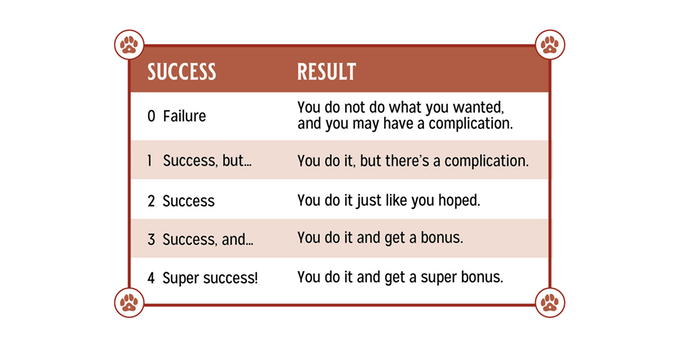
In Magical Kitties Save the Day, it’s not just a question of whether or not you succeed: It’s about HOW you succeed. The complications and bonuses generated by most outcomes drive the action forward in unexpected and exciting ways.
Other interesting game play elements:
- Character generation takes just 5 minutes.
- The dice are always in the players’ hands, not the GM’s.
- Players get Kitty Treats that let them change the story. You earn Kitty Treats by roleplaying your Flaw.
- No one ever dies in Magical Kitties. If you take too many Owies, you get knocked out or otherwise “incapacitated” for the scene.
- You get XP for every time you fail a roll. And for saving the day, of course!
Read the Basic Rules
Now you’re ready for the real thing! Read the game rules from page 24-33 of the Rulebook. Yes, it’s only 10 pages!

Find the Rules Cheat Sheet
Now flip to the inside back cover of the Rulebook. Ta da! Everything you just read is summarized here.
If you’d like a little help with anything you read, don’t forget about the New Gamemaster Month Facebook page. And if this starts to feel intimidating, remember that GMs don’t need to memorize all this! You’ll always have the game books right next to you for the entire game. Read and understand them, but don’t let them drag you down, because the story should always come first.
Speaking of which, we’ll be back on Thursday to talk about the adventure! 😻
It’s time to dig into the rulebook a bit for more rules and setting information. Read through these sections:
- Clues, Tests and Contests: The core rules are on pages 51-58. There are more special-case rules in the rest of the chapter, but you don’t need to read those yet – just take a quick skim. These rules cover the two key aspects of the GUMSHOE rules: the clue-finding, always-succeeding Investigative Abilities, and the danger-defying, roll-and-pray General Abilities.
- Read the descriptions of the various abilities on p. 28-48. You don’t need to know them in detail, just get a taste of what sort of investigative tools and abilities the players have.
- Ghouls: Page 133 is the relevant part of the Cthulhu Mythos chapter for Midnight Sub Rosa, but you should also take a look around the rest of the chapter to marinade in the Mythos.
If you’re new to the GUMSHOE system and some things don’t make sense right away, don’t lose too much sleep over it yet. RPGs, like almost all games, are easiest to grok by playing rather than by reading the rules. But if you’d like a little help with anything you read, don’t forget about the New Gamemaster Month Facebook page!
Enjoy your reading, and we’ll talk again on Thursday!
As the gamemaster, your players will be looking to you for answers about things they don’t understand. Let’s get those answers ready.
Get familiar with the character sheets. You don’t need to remember any specific values or scores for characters, just know where everything is so you can direct your players to the right place if and when they ask.
If you aren’t familiar with Basic Roleplaying, now’s the time. You don’t need to become an expert, only to understand the game’s most fundamental pieces.
- Rolling dice, success, and failure
- Skills and attributes, and how to use them
- How to make an attack and deal damage
That’s enough for our purposes here. If you and your players have fun and want to play more, you can always do more work later. For now, just focus on what you need to do to get playing.
We’ll talk again on Thursday!
Setting
Our sample adventure, Dream Away the Time, is set in the present day, in the village of Handfast. We know it has a forest nearby and was settled in 1615. The rest of the details are left open for you to tailor and improvise. Think about what this village is like in the modern day. What country is it in? Is it a sleepy little town or an up-and-coming suburb? Don’t worry about getting every single detail nailed down, the players can also help contribute during the game. Just think about what you want Handfast to feel like – whether that’s suburban dystopia, darkly whimsical fairytale, or something else altogether.
Rules in a Nutshell
If this is your first time playing a game Powered by the Apocalypse (PbtA), there are three key concepts you should read and review: Playbooks, Ratings, and Moves.
Playbooks represent archetypes (e.g., the Spell-Slinger, the Mundane, the Expert, etc.). Everything a player wants to do with their character is in their Playbook. Important: there can only be one of any given playbook at the table.
Ratings represent how good each Hunter is at certain areas of monster hunting. They range from -1 (bad) to +3 (phenomenal) and add to the dice total when players roll for a move.
Moves cover situations where a hunter tries to do something normal people can’t do, something dangerous (like fighting), or something where the outcome becomes more interesting when we roll the dice (like when a Hunter tells a lie to an NPC). There are eight basic moves that every hunter can use. Each playbook also has its own special moves.
Keepers also get to make moves! A soft move threatens danger or foreshadows how things will get worse if the Hunters don’t act. A hard move doesn’t give the party that chance to react. They just suffer the consequence, whether it’s harm or an NPC dying, or whatever is appropriate to the situation at hand that triggered the move.
A final key element in PbtA games is that play is asymmetrical. The players do all the dice rolling. As the Keeper, don’t have to roll to see if your monster hits and does harm: if a Hunter’s roll triggers harm, it does harm – unless the hunters have a move which can prevent that harm. This way you don’t have to get bogged down in stats and fidgety dice rolls, you can focus on responding creatively and appropriately to the Hunters’ actions.
Sections to Read & Review: Before You Get Started (pages 25-27); How To Play, Big Magic, Fights, Harm, and The Luck Counter (pages 96-113); Dream Away the Time (pages 150-161) Running the First Mystery (pages 166-175).
If You’re Using Roll20
Explore the Roll20 character sheet by making a few sample hunter characters. Notice how choosing a playbook changes the options available, and how you can hide unused options. Check out the Hunter Moves Reference section right near the top of the sheet, which provides the players not only with a way to roll the dice but with detailed descriptions of the basic moves and a rules cheat sheet.
Welcome back, Handler. Last week’s actionables were as follows.
- Primary Objective A: Read “Last Things Last,” pages 41–48 in Delta Green: Need to Know.
- Primary Objective B: Collect player schedules for the first two weeks in February and find a time to play the game.
- Primary Objective C: Plan and prepare a meeting space, either online or in person. Gather materials needed as listed on page 6 of Need to Know.
- Primary Objective D: By email or chat, discuss the game with the players. Decide whether players will develop their own Agents or use the pregenerated Agents from Need to Know. Ensure everyone understands the nature of Delta Green and is ready to play its kind of horror.
- Primary Objective E: For an online game, schedule a brief online meeting to test software.
Today we learn about the setting of Delta Green and its rules. This is the skill-based portion of the course. Still, we’re going to keep in mind the big charlie-foxtrot that scheduling is likely to provide. We’ll keep it light.
Here’s What You Need to Know about Delta Green
Unnatural, alien forces threaten the survival of humanity. Certain isolated members of the U.S. national security apparatus have parceled out what paltry defense they may. Delta Green is a secret organization worming its way through the guts of American federal government and law enforcement. Like all things human, the organization’s effectiveness rises and falls. At times it has been a well-funded machine of state. At others it has been so far out of political favor as to be entirely unsanctioned and illegal. In the modern day, both states exis: an official version of Delta Green called “the Program” and an illegal conspiracy of “Outlaws.” Whoever you work with, the fight against the dark calls urgently. There is not much time left before the end. And there is much work left to do.
There: you understand all you need to know of the setting of Delta Green.
…yes, of course there’s more. But you don’t need to know more yet, and I’m not wasting breath on rookies. Let’s see if you even survive the first op first.
Now We Learn the Rules of the Game
Delta Green: Need to Know condenses this information admirably between pages 5 and 18 and pages 33 to 39, but allow me to SparksNotes the Cliff’s Notes. Here’s the absolute minimum reading required to run the game.
- Pages 41–48, “Last Things Last” (done last week)
- Pages 5–9, “Welcome to Delta Green”
- Pages 11–19, “What Is an Agent?”
- Pages 33–39, “Game System”
Sometimes It Is Easier to Work from an Example
Luckily, a number of resources are available. You can find the creators of Delta Green playing it on YouTube. Full Delta Green campaigns are available online on podcasts such as Role Playing Public Radio, Great Old Ones Gaming, and Black Project Gaming. There are many more of outstanding quality. Watch or listen as time allows.
That’s it for today. Light duty. Take it where you can get it.
Actionables:
- Primary Objective A: Learn the Delta Green setting (COMPLETE).
- Primary Objective B: Learn the game’s rules by reading Need to Know, pages 5–19 and 33–39.
- Bonus Objective: Watch or listen to actual plays of Delta Green.
Welcome back to the third installment of the Tales of the Valiant roleplaying game as part of New Gamemaster Month!
One of the most daunting aspects of becoming a game master (GM) is overcoming the fear of “not knowing everything.” No GM knows every detail, and you don’t need to feel like you do either. However, a solid understanding of the rules and the setting is crucial. This knowledge ensures that gameplay flows smoothly without frequent interruptions to check the rulebook.
You don’t need to memorize every aspect of the rules in the Tales of the Valiant Player’s Guide, but familiarity with the basic rules helps.
A Video to Watch
Today, we explore the basic rules in the Player’s Guide. Watching others play can help you learn more quickly. So let’s start with a video of a live play session of Tales of the Valiant.
This gameplay video is about 90 minutes long, so watch as much of it as you’d like. While you’re on the Kobold Press YouTube channel, you can also find additional helpful videos related to the Tales of the Valiant RPG!
EXERCISE: Foundational Rules
After watching the video, take a moment to review a section of the rules in the Players Guide—specifically in Chapter 6. We highlighted the most important parts to get started quickly.
Chapter 6 of the Players Guide:
- Rolling the Dice, pages 203–205
- The Three Types of Checks, pages 206–207
- Movement, pages 211–213
- Life and Death, pages 217–221
This section is about 13 pages in total, so it will take some time to read. The design team at Kobold Press included helpful footers and sidebars to organize and condense the information. If you are new to Tales of the Valiant or 5th Edition Dungeons & Dragons and don’t get it all on the first pass, don’t sweat it. Like most games, role-playing games come to you more easily through play rather than by just reading the rules.
If you need help with this exercise, join us on the New Gamemaster Month Facebook page or on the Kobold Press Discord channel. You can connect with other new game masters there throughout January. We can chat there and answer any questions you have.
Enjoy the video and your reading, and we’ll be back on Thursday, where we’ll jump into the adventure!
📺 Learn with Video
If you’re an audio/visual learner, you can learn the basics of Savage Worlds in just 7 minutes with this excellent video playlist from the folks at the Saving Throw Show: Savage 60 Seconds.
📖 The Core Concepts
Start with pages 2-3 of the Test Drive. Savage Worlds characters have five Attributes (Agility, Smarts, Spirit, Strength, Vigor) and several skills, each tied to a specific die type (d4, d6, d8, etc.). These are collectively called Traits.
To make a roll, simply roll the die associated with the Trait, along with an extra d6 (called the Wild Die), and use the better result.
🔢 Four is the Magic Number
A roll of 4 or higher is typically a success. As you gain experience as a GM, you can adjust this target for tougher situations.
- Raises: Beating the target by 4 or more (e.g., rolling 8 when the target is 4) is called a raise and represents an especially impressive success.
🎲 Aces: When Dice Explode!
Any die rolled for a Trait can Ace, meaning:
- If it rolls its maximum value, roll again and add the results together.
- A die can Ace repeatedly, so even a lowly d4 can roll an extraordinarily high number.
- Both the Trait die and the Wild Die can Ace independently—keep rolling and take the better final result.
🎯 Get Rolling Early
Start your session by having characters make a simple roll, like a Notice check. This helps everyone get comfortable with Trait rolls before diving into the action. Most rolls in the game work the same way, so once this is understood, gameplay will flow smoothly!
Dungeon Crawl Classics is fun and easy to learn, and the best part is that the rules are designed to let you, the Judge, flex your game to meet the style of play that you most enjoy. And as we’ve stated before, you don’t have to memorize the rules. The rulebook is there as a reference and a tool to be used.
That said, it’s a good idea to have a grasp on some key aspects of the game.
There are a handful of things that are vital to playing DCC RPG, and we’ll go over them with you now.
- The Core Mechanic: Everything starts with the dice. What happens with the dice and the things you need to know about our game is included in what we call The Core Mechanic. You can find everything about the Core Mechanic on page 12 of the core rulebook.
- The Dice Chain: The Dice Chain is the core mechanic of Dungeon Crawl Classics, and one of the things that makes DCC RPG unique. You can find information about the Dice Chain starting on page 17 of the core rulebook.
- The Skill Check: At various times in the game, it is highly likely that the PCs will have to make a Skill Check. The rules and conditions for this begin on page 66 of the core rulebook.
- Combat: Action is one of the things that makes Dungeon Crawl Classics exciting, and the most common form of action in the game is combat. You can find the rules on combat beginning on page 76 of the core rulebook.
And those are the most important things to know! With those four bits of information in your repertoire, you are almost ready to begin!
Of course, if you want to dig a little deeper, no one is going to blame you. And we do have some more resources that you can access to get you started with DCC RPG.
Videos and Other Resources
Watching others is a great way to learn, and thanks to the internet, you can watch them at home anytime you’d like.
We have an entire playlist of videos focusing on different aspects of playing DCC RPG, and watching them might be beneficial to your learning experience.
And your fellow gamemasters are also a fantastic resource. You can visit the sub-Reddit r/dccrpg and read other’s comments, or post questions of your own. There is also the official Goodman Games Discord channel where you can converse with other Judges and players to get a feel for any aspect of the game. And the DCC Rocks! Facebook Group is filled with fans who love to help out anyone and everyone.
Next time, we’re jumping into the adventure!
Now that you’ve got the basics, it’s time to step deeper into the rulebook. But remember the Golden Rule we read about on page 7: “The most important rule of Daggerheart is to make the game your own. The rules included in this book are designed to help you enjoy the experience at the table, but everyone has a different approach to interpreting rules and telling stories.” Hold on gently and remember to prioritize the fun you and your friends are having at the table.
And while other New Gamemaster Month participants will be deep diving into their worlds, Daggerheart doesn’t have a single setting, world, or lore to learn. Instead, the Quickstart Adventure is set in the location of the Sablewood, which you could drop into lots of fantasy-friendly worlds, and you’ll be encouraged to make that setting your own through play!
Watch
You’re ready for our instructional video series “Get Your Sheet Together”!
- Watch “How to Play Daggerheart,” and consider sharing with your players so they can get prepared too!
- Watch “Game Mastering in Daggerheart” for your side of the equation!
Read
Returning to the Daggerheart Core Rulebook, next focus on:
- Core Mechanics on pages 87-109 to understand all the rules that affect the players. While you do, remember to glance at the Play Guide from the “Additional Sheets” file on our Downloads page. You’ll want to provide this guide to your players for their session, and it can be handy to know where the rules will be referenced on their sheet so you can guide them.
- Page 134 for a full example of play.
- Core GM Mechanics on pages 140-160 (stopping before “Adversary rolls”), giving you all you need to understand for you to run games and support your players. While you do, glance at the GM Guide from the “Additional Sheets” file on our Downloads page. This will serve as your in-the-moment reference when you’re running your game and might want to recall how to call for an action roll, what GM moves are available to you, and more.
In the Quickstart Adventure, read:
- The GM Adventure Guide on pages 22-27, which teaches you how to take what you’ve learned above and easily teach that to your players. During your play session in February, you will be walking your players through this part of the packet with read-aloud text.
Throughout this program, we have expert GMs on hand to answer questions and provide general support at the New Gamemaster Month Discord Server or the New Gamemaster Month Facebook group. Please drop in, join the group, introduce yourself, and ask any questions you might have. Other new GMs will also be there—it’s a great place to share your experiences and support one another. Hope to see you there!